
10 enterprise PPC agencies to consider
Tinuiti, Wpromote, Brainlabs, Jellyfish, iProspect, NP Digital, Seer Interactive, Directive, Ignite Visibility and Power Digital are the ten choices in this guide. The best fit depends on your business model, measurement needs and delivery requirements.
- TinuitiCommerce-led cross-channel scale
- WpromoteFirst-party search integration
- BrainlabsExperimentation and incrementality
- JellyfishMultinational product advertising
- iProspectGlobal integrated media
- NP DigitalShopping and product-feed optimization
- Seer InteractiveAnalytics and offline conversion tracking
- DirectiveB2B pipeline generation
- Ignite VisibilityFranchises and multi-location businesses
- Power DigitalPaid media with conversion optimization
How to read this list: the numbers help you navigate; they are not performance scores. Fit labels are editorial judgments based on the sources below. We have not hired or tested these agencies, obtained quotes, or independently audited their results.
How these agencies were selected
We looked for an explicit paid-search offering, capabilities relevant to enterprise complexity, a US-facing offering or presence, and enough public detail to explain a distinct reason to investigate the agency. This is a researched shortlist, not a comprehensive census of every eligible provider.
“Enterprise” here means a program with several interdependent needs: multiple markets or business units, substantial product data, offline sales, approval layers, or search coordinated with other media. A large ad budget alone does not settle which operating model you need.
Agency service pages establish what the providers say they offer. Selected case studies illustrate specific work; they do not prove typical results, current client relationships or superior performance against competitors. We did not use star ratings, paid directory positions or unlike-for-like case-study percentages to produce a ranking.
Our practical recommendation: start with two or three agencies whose documented approach matches your bottleneck, then give them the same brief. Verify the team, scope, relevant references and commercial terms before deciding. No agency paid for placement in this demonstration.
Compare the ten agencies
Use this table to choose which profiles to read first. The final column is a diligence question, not a claim that an agency lacks the capability.
On a narrow screen, swipe the table sideways to read all three columns.
| Agency | Documented emphasis | Confirm in your proposal |
|---|---|---|
| Tinuiti | Search, shopping and broader media measurement | How search decisions use the wider measurement plan |
| Wpromote | Paid search connected to first-party customer insight | Ownership of paid, organic and customer-data decisions |
| Brainlabs | Experimentation, measurement and complex search programs | What can realistically be tested with your data and budget |
| Jellyfish | Product advertising and multi-market campaign coordination | Central governance versus local-market execution |
| iProspect | Paid search, first-party data and cross-channel planning | How the search team works with other media owners |
| NP Digital | Shopping, Performance Max and product-feed work | Product economics and feed responsibility |
| Seer Interactive | Offline conversion tracking, feeds and cross-channel reporting | Data implementation versus campaign management responsibilities |
| Directive | B2B paid search connected to CRM stages | Pipeline definitions, attribution and sales-cycle delays |
| Ignite Visibility | National/local coordination and location-level reporting | Brand guardrails and local spending authority |
| Power Digital | Paid search linked to broader media and CRO | Whether landing-page and creative work are included |
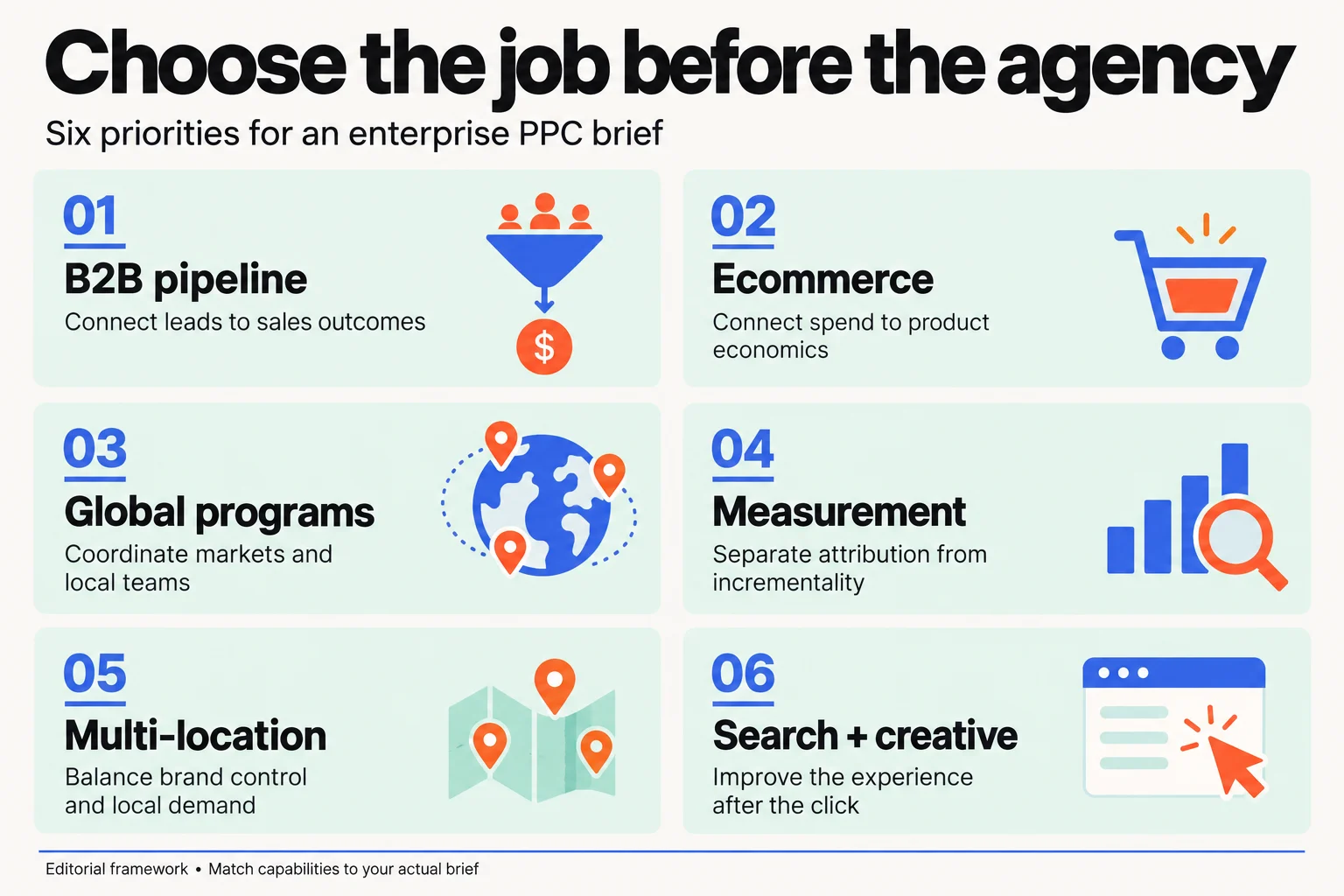
1. Tinuiti
Tinuiti is a useful starting point for a commerce business that needs paid search to work with shopping, creative and other media. Its paid-search service describes audience and creative testing alongside its Bliss Point measurement platform. That makes it a plausible choice when the problem extends beyond bid management. Source: Tinuiti paid search.
Its historical e.l.f. Cosmetics case describes coordinating search, shopping, social and display, with reporting and product-feed work. The case refers to an engagement beginning in 2019 and older comparison periods; it illustrates an operating approach, not a forecast for your 2026 program. Source: e.l.f. case study.
Scope to confirm: whether your proposal includes feed support, creative production and measurement specialists, or only paid-search management. A broader agency offering does not mean every discipline is included in your fee.
Ask: “Show how the search team would change budget allocation when platform ROAS and your broader measurement disagree.”
2. Wpromote
Consider Wpromote when your paid-search brief depends on understanding customer value and coordinating paid and organic search. Its service page covers paid-search strategy, creative and AI-driven platforms, while its QuickBooks case provides a more concrete example of using first-party insights across the search journey. Source: Wpromote paid search.
In that agency-reported case, Intuit QuickBooks used customer data to inform bidding, content and the relationship between paid and organic search. The useful procurement signal is the connection between customer insight and execution, rather than an isolated headline lift. Source: QuickBooks case study.
Scope to confirm: the data your team must supply, who prepares it, and whether SEO collaboration is included. This fit is less persuasive if the engagement is tightly limited to daily account operation with no access to downstream customer outcomes.
Ask: “Which first-party signals would change our bids, and who owns the work required to make those signals reliable?”
3. Brainlabs
Brainlabs merits a look when leadership needs a disciplined testing program and a clearer view of incremental contribution. Its public offering connects media execution with marketing-mix modeling, incrementality experiments and attribution. Its “Test and Earn” approach puts experimentation at the center of the proposition. Source: Brainlabs capabilities.
Its enterprise Search Ads 360 article discusses portfolio and budget bidding for complex search programs. The Anglian example is UK-specific, so it should not be treated as direct evidence of US results. It does, however, make the paid-search operating approach more concrete. Source: enterprise search approach.
Scope to confirm: whether experiments, modeling and platform work are in the proposed scope, and whether your data volume can support the suggested tests. An attractive experimentation framework needs a feasible implementation plan.
Ask: “Propose one decision-changing experiment, including its assumptions, required data and what you would do if the result were inconclusive.”
4. Jellyfish
Jellyfish is a relevant candidate for an enterprise coordinating product advertising across markets and platforms. Its paid-search offering describes product advertising, Google Marketing Platform integration, discovery audits, onboarding and ongoing reporting. Source: Jellyfish paid search.
The reason to consider it is operational: product data, technology and local campaign execution can become separate workstreams in a multinational organization. A provider that discusses these together may fit a brief involving shared infrastructure and different market needs. That is an editorial inference from the documented offering, not proof that its model will fit your internal structure.
Scope to confirm: which markets the contracted delivery team actually covers, how localization is approved, and who fixes product-feed issues. Do not assume a global capability statement guarantees a dedicated local specialist in every market.
Ask: “Walk us through a product launch across three markets, naming the owners of feed quality, local copy, budget changes and reporting.”
5. iProspect
iProspect is worth evaluating when paid search must sit inside a coordinated global media strategy. Its service page describes connections between paid search, SEO and upper-funnel activity, along with first-party CRM data and local linguistic and creative execution. Source: iProspect paid search.
That combination is relevant for a marketing leader managing multiple brands or regions whose teams otherwise optimize channels separately. The appeal is a joined-up operating model: a change in brand activity, local demand or customer mix should be visible to the people making search decisions.
Scope to confirm: whether your engagement will actually include cross-channel planning and local-market support. A search-only statement of work may not deliver the coordination implied by a broader network offering. Ask how decisions move between your in-house teams, agency specialists and regional stakeholders.
Ask: “When an upper-funnel campaign changes branded demand, how will you report search performance without crediting search for all of that demand?”
6. NP Digital
NP Digital is a plausible shortlist choice for retailers whose search program depends on product feeds and shopping execution. Its paid-search offering includes Performance Max, Standard Shopping, Demand Gen and other Google formats. Source: NP Digital paid search.
Its ZAGG case describes enhanced conversions, target-ROAS bidding, supplemental product feeds, category work and campaign consolidation. Those are concrete areas to investigate if catalog structure or measurement quality is limiting your program. The case is agency-reported and does not establish a typical outcome for other retailers. Source: ZAGG case study.
Scope to confirm: who maintains the feed and how inventory, margin and new-customer value affect optimization. Ask for examples comparable to your catalog and trading conditions, rather than treating a recognizable client name as sufficient evidence.
Ask: “How would you distinguish profitable growth from a higher platform ROAS driven by brand demand or a changing product mix?”
7. Seer Interactive
Seer Interactive is a strong candidate to investigate when the bottleneck is the connection between media activity and downstream outcomes. Its paid-media offering explicitly includes offline conversion tracking, feed management, automated bids and budgets, cross-channel reporting and testing. Source: Seer paid media.
For a business that closes sales after a call, demo or sales conversation, those capabilities matter because an initial conversion is only part of the journey. The practical question is whether the agency can help make later outcomes usable in reporting and optimization, with clear ownership across your CRM and advertising teams.
Scope to confirm: what engineering, analytics or CRM work your team must deliver before the media strategy can operate. Public capability descriptions do not establish integration effort, implementation fees or the availability of particular specialists.
Ask: “Map one lead from ad click to closed business, including identifiers, quality checks, delays and responsibility for broken data.”
8. Directive
Directive is a relevant specialist option for B2B organizations that need search tied to pipeline, rather than only form submissions. Its PPC offering describes Google and Microsoft campaigns, competitor and category search, landing-page optimization, CRM stages and offline conversions. Source: Directive PPC services and case evidence.
The same page describes work for Skillable involving channel focus, branded and non-branded terms, changes to Performance Max activity and offline data. Use that example to ask how strategy responds to lead quality and longer buying cycles. Do not assume the channel changes from one account are the correct prescription for yours.
Scope to confirm: whether both sides agree on qualified pipeline, opportunity stages and the period used to evaluate results. A reported increase in leads is not interchangeable with better pipeline, and a B2B specialization still needs evidence relevant to your sales motion.
Ask: “Which CRM stage should inform bidding now, and how will you validate that it predicts revenue rather than merely more activity?”
9. Ignite Visibility
Ignite Visibility is worth considering for franchise or multi-location organizations balancing national brand direction with local demand. Its franchise offering discusses PPC, geo-targeting, location-level reporting and coordination among corporate marketing teams, field teams and franchisees. Source: Ignite franchise marketing.
This fit is about governance as much as campaign execution. A national report can hide weak individual locations; unrestricted local changes can undermine brand consistency. The public offering addresses both sides of that operating problem, making it a useful candidate for a geographically distributed brief.
Scope to confirm: how budgets, approvals and reporting work at each level, and which local activities are included in the fee. Request a demonstration using a realistic mix of mature, new and underperforming locations rather than a single aggregate dashboard.
Ask: “What can a local operator change, what requires central approval, and how will we identify a location that is spending without producing qualified demand?”
10. Power Digital
Power Digital is a useful candidate when improving traffic quality and improving the post-click experience belong in the same brief. Its paid-media offering covers search, shopping, Performance Max and other channels, and connects that work with conversion-rate optimization and iterative testing. Source: Power Digital paid media.
The potential advantage is fewer gaps between the team buying traffic and the team responsible for what visitors see next. That matters when an account can generate relevant visits but the offer, page or buying journey prevents those visits from becoming useful business outcomes.
Scope to confirm: whether your proposal includes research, design, development and experiment implementation on landing pages. A recommendation deck is a different deliverable from a working test. Establish who can ship changes and how competing marketing priorities affect that work.
Ask: “Show the handoff from a search insight to a live landing-page experiment, including who builds it and how the result changes the next campaign decision.”
What should an enterprise PPC proposal cost?
The reviewed pages do not provide a consistent set of comparable enterprise quotes. Publishing a single “typical” fee would hide differences in markets, channels, creative, technology and implementation. Request a scoped proposal instead of treating an unsupported monthly figure as a benchmark.
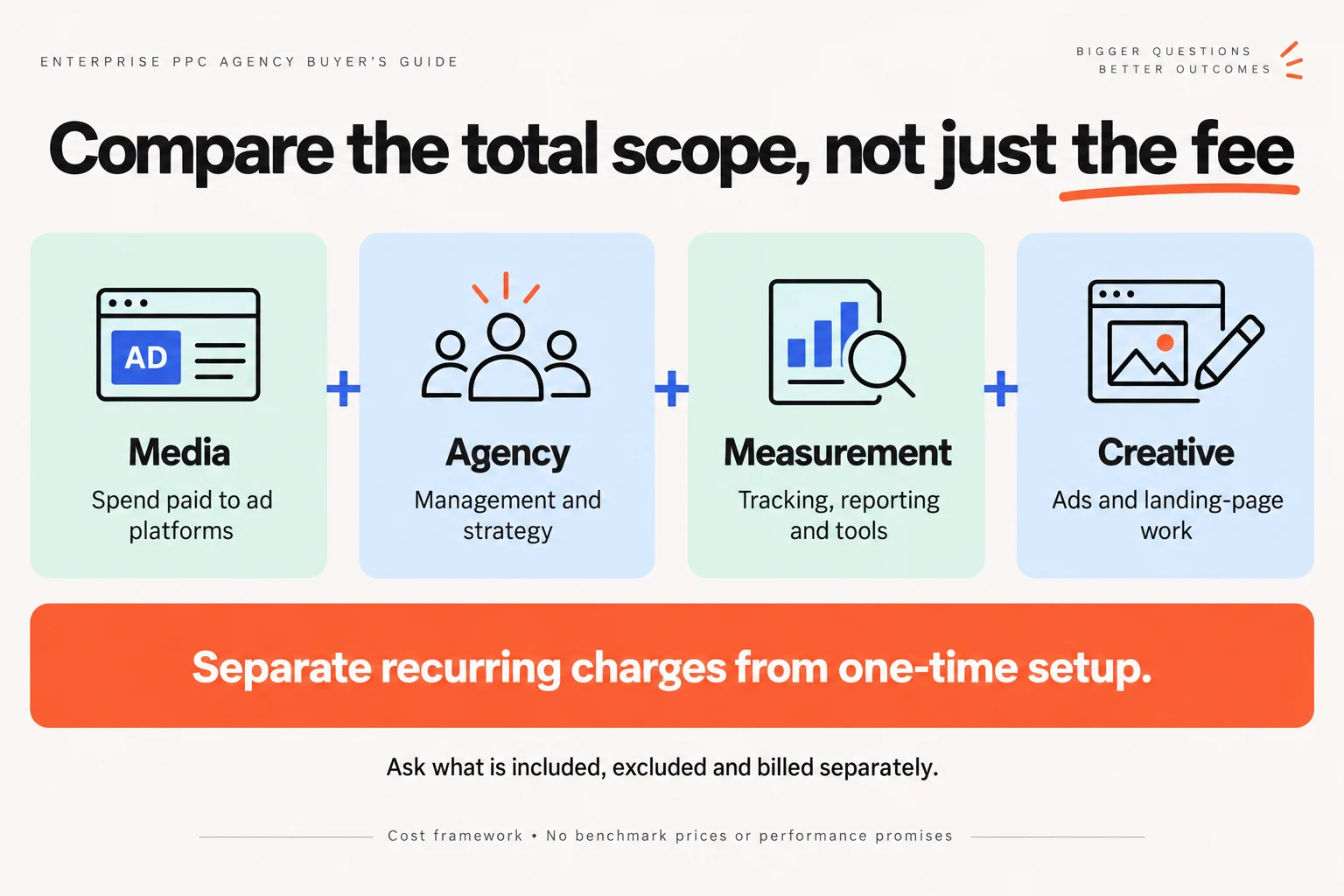
Give every shortlisted agency the same assumptions: markets, business units, platforms, catalog size where relevant, existing technology, internal support and expected deliverables. Then ask them to separate:
- Media spend: money paid to advertising platforms, with billing and reconciliation responsibilities.
- Agency services: strategy, day-to-day management, meetings, reporting and the staffing assumptions behind the fee.
- Measurement and technology: tracking implementation, feeds, integrations, dashboards, licenses and ongoing maintenance.
- Creative and conversion work: ads, landing pages, testing, development and the volume of included revisions.
For any percentage-based charge, specify which spend it applies to. For retainers or project fees, specify included capacity and change-request rules. Ask how additional markets, a platform migration or new creative requirements would change the proposal. The goal is comparable scope, not an artificially precise cost calculator.
A five-step process for choosing your agency
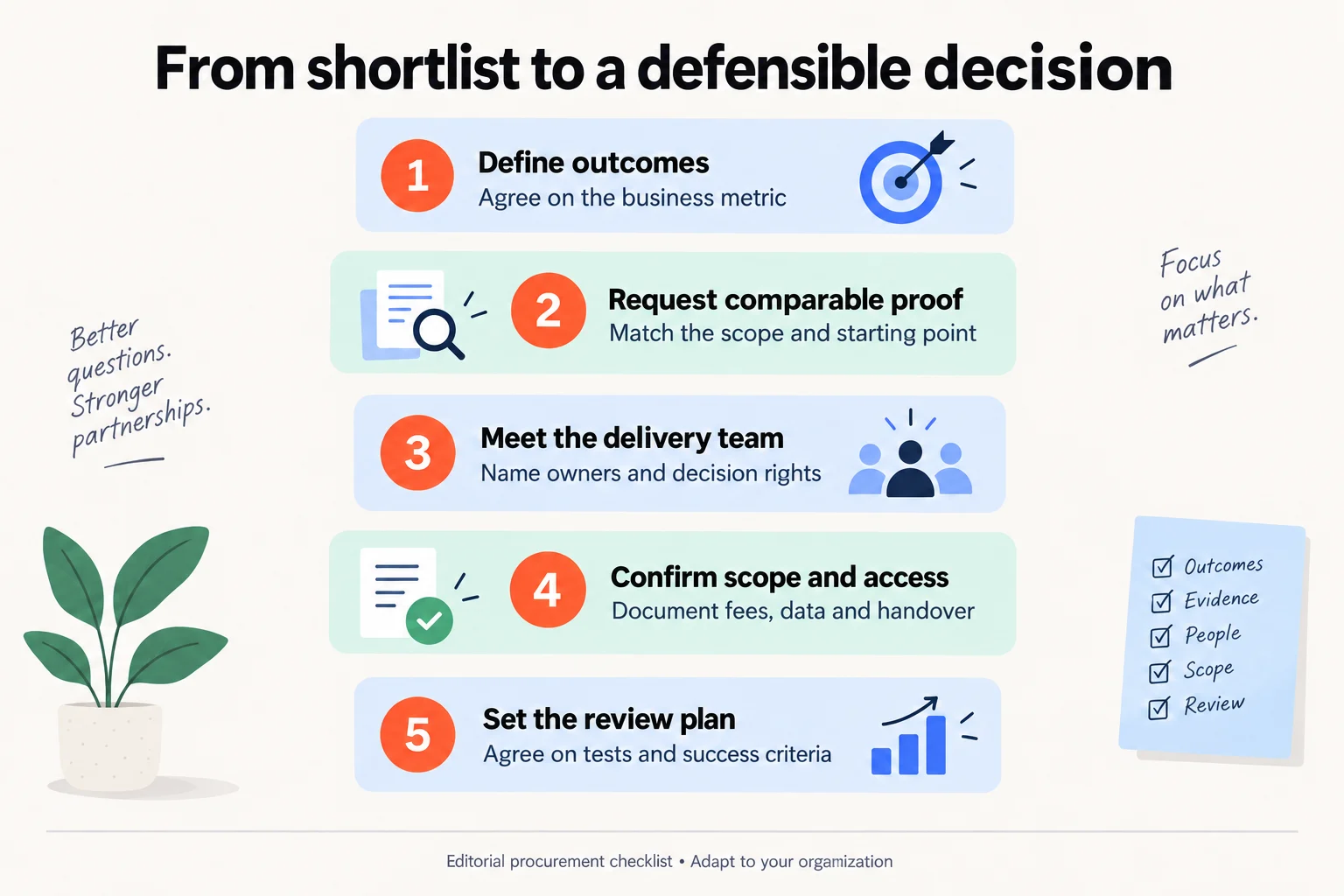
1. Define the outcome and the current constraint
Write a one-page brief stating the business outcome, the present bottleneck and what the agency will control. A B2B team might prioritize qualified opportunities; a retailer might focus on profitable customer acquisition. Include your existing baseline and the limitations of the data. If nobody agrees what a useful conversion is, settle that before comparing promises.
2. Request evidence you can actually compare
Ask for a case with a similar business model, scale of complexity and starting problem. Request the baseline, time period, agency scope, other changes during the engagement and how the outcome was measured. A large percentage improvement without that context is not a sound basis for choosing a partner. Ask for a relevant reference when the agency can appropriately provide one.
3. Meet the people who will deliver
Identify the account lead, search specialist and any analytics or creative owners. Clarify senior oversight, meeting cadence, escalation and how staffing changes are handled. Have the delivery team explain an actual decision using your brief; the quality of the reasoning matters more than the polish of the pitch.
4. Confirm scope, access and handover
Document deliverables, fees, client responsibilities and what happens at the end of the engagement. Retain appropriate in-house administrative access and review manager-account permissions. Google explains that manager ownership does not remove client ownership or data rights, and a client can unlink a manager. Evaluate the actual permissions and operating arrangement rather than treating the word “ownership” alone as a warning sign. Source: Google Ads manager-account ownership.
For businesses with offline outcomes, ask how those outcomes reach the advertising platform and how failed or delayed uploads are detected. Check the proposed integration against Google’s current documentation; a workflow built around an outdated implementation should not pass technical review simply because the dashboard looks good. Source: Google offline conversion imports.
5. Agree on the review plan before kickoff
Set success criteria, reporting definitions and an initial learning plan that fits your sales cycle and available data. Agree which decisions early results can support and which require more time. Include implementation milestones so tracking, feeds or landing-page delays are visible rather than silently confused with media performance.
Enterprise PPC agency FAQs
Which enterprise PPC agency is best overall?
This research does not establish a single overall winner. Start with Directive for a B2B pipeline brief, Tinuiti or NP Digital for commerce-related needs, Jellyfish or iProspect for global coordination, and Ignite Visibility for franchises. These are starting points based on the capabilities discussed above; verify fit through a common brief and delivery-team review.
How many agencies should we shortlist?
Two or three is a practical starting point for a focused comparison, not an industry rule. Choose candidates that can solve the same priority problem so their proposals are meaningfully comparable. Your procurement requirements may call for a different number.
Do we need a full-service agency or a PPC specialist?
Choose according to the work you need covered. If your in-house team already owns reliable measurement, creative and landing pages, a narrower scope may be enough. If those responsibilities are fragmented, evaluate a coordinated team and document exactly which disciplines the contract includes.
Are the numbers in this list a ranking?
No. They make the page easy to navigate. We did not score performance, compare quotes or run controlled tests across these agencies. The fit labels are editorial inferences from public service pages and selected case studies.
What should we verify before signing?
Confirm relevant references, the actual delivery team, measurable objectives, complete fees, client responsibilities, account permissions and handover terms. Make sure the proposed reporting can distinguish the outcome you need from a convenient platform metric.